




 17 Min
 In Pharmacy First

Follow this topic

Bookmark

Record learning outcomes
Assessment, diagnosis and management of impetigo
This toolkit is designed to support pharmacists and their teams to deliver Pharmacy First (and similar services in the UK) for impetigo. It covers:
- Clinical assessment and decision-making
- Management of the condition
- Communicating with patients about treatment decisions.
|
After reading the toolkit you will be able to:
|
|
||||||||||
Definitions and prevalence
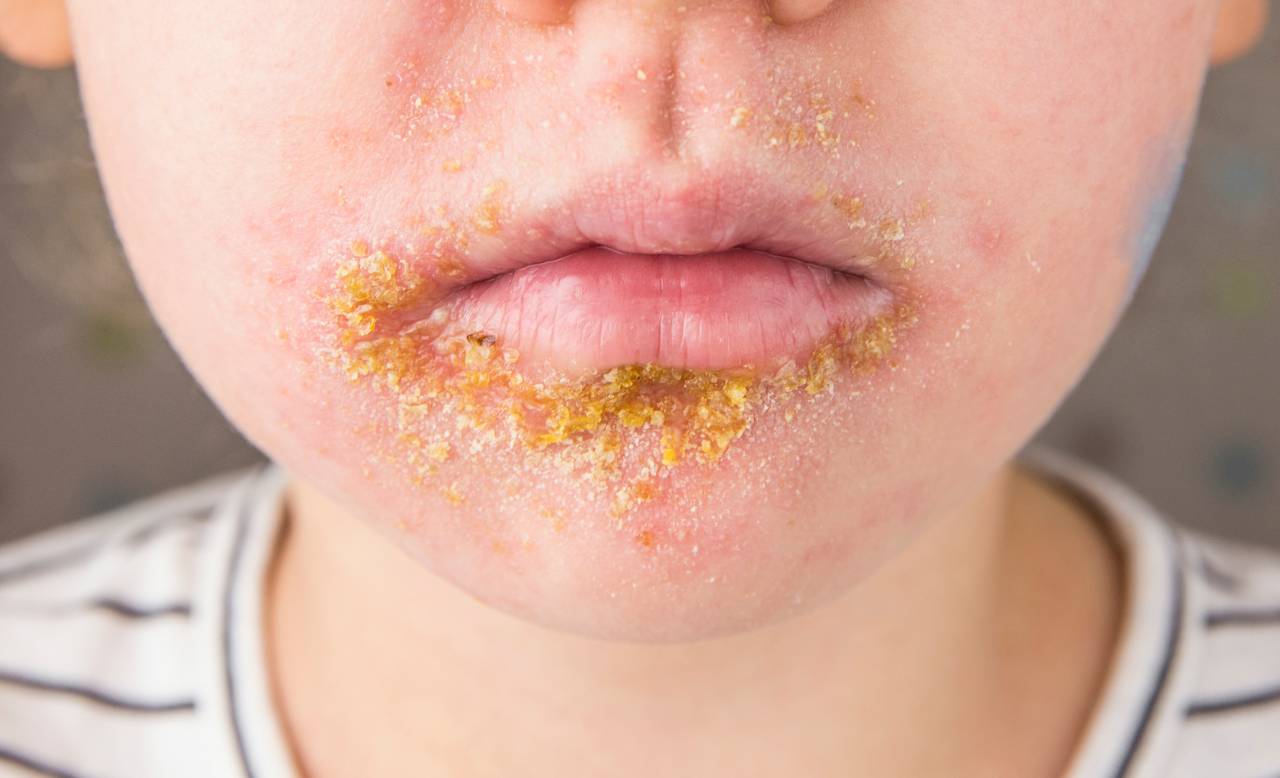
Impetigo is a common skin infection, especially in young children. Parents may attend the pharmacy with their child, concerned that it is a serious or worrying condition such as scabies or cellulitis. They may also worry whether the child has an underlying skin condition such as eczema.
Most impetigo cases are uncomplicated but highly infectious. They can usually be managed with a short course of topical hydrogen peroxide or a topical antibiotic. Only more severe or complicated disease will require oral antibiotic treatment.
It is important to reassure parents once you are confident of a diagnosis, as it is usually a simple condition to treat (although, as ever, children with immunosuppression should be treated with caution).
Impetigo is caused when bacteria enter the skin through breaks caused by minor trauma such as insect bites or scratches, or underlying skin conditions such as eczema or scabies. The incubation period is 4-10 days.
There are two forms of impetigo – bullous and non-bullous. Non-bullous impetigo is caused by Staphylococcus aureus, Streptococcus pyogenes or a combination of both. Bullous impetigo is caused by Staphylococcus aureus. Impetigo caused by methicillin-resistant Staphylococcus aureus (MRSA) is becoming increasingly common.
Transmission occurs directly through close contact with an infected person or indirectly via contaminated objects such as toys, clothing or towels. Risk factors include skin trauma or pre-existing skin disease, hot/humid weather, poor hygiene and crowding.
Cases are most common in children aged between 0-14 years of age. Annual incidence is around 2.8% in children up to 4 years of age and 1.6% in children aged 5-15 years.
The most common form of the disease is non bullous impetigo, which makes up approximately 70% of cases and where large outbreaks can occur.
Clinical progression
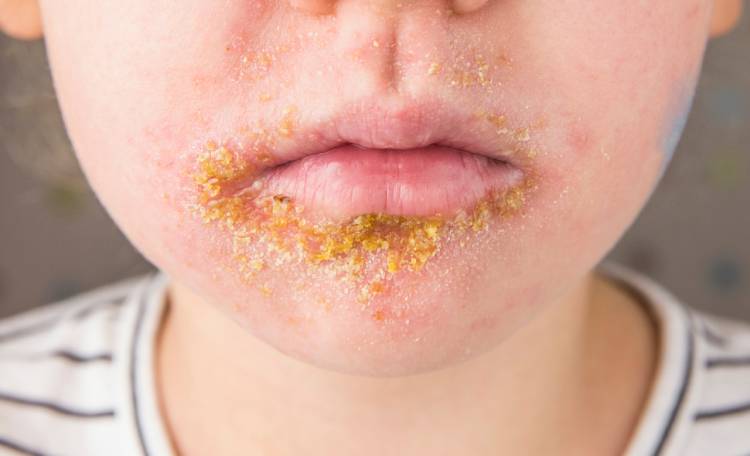
Impetigo starts as small, thin-walled vesicles that burst quickly, leaving an exudate that dries to form a thick yellowish (honey-coloured) or brown crust. It is often described as looking like stuck-on cornflakes.
Lesions typically appear on the face, around the mouth or nose, but can also occur elsewhere on the body (e.g. axillae or trunk). Lesions often occur in clusters and can coalesce. Satellite lesions can develop as a result of autoinoculation from scratching or touching the original lesions.
The crusts dry and heal without scarring over 2-3 weeks. There may be residual redness that fades over days or weeks. A diagnosis is usually based on the clinical appearance and history.
If there is damage to the skin – for example, due to eczema, scabies or insect bites (including head lice) – the impetigo may become more widespread as the damaged skin provides a portal for entry of bacteria.
Systemic symptoms are usually absent. Patients do not have sore throats but may have regional lymphadenopathy. There is usually little or no evidence of deep-seated infection (tissue inflammation, swelling or redness).
Bacterial culture is not routinely required unless there is recurrent or poorly responsive infection or methicillin-resistant Staphylococcus aureus (MRSA) is suspected.
The main risk factors for impetigo are young age (under 5 years), contact with other cases, and crowded living or work conditions.
Taking a history
When taking a patient history, ask about:
- The appearance, onset, evolution, duration and location of lesions
- Whether there has been contact with others with impetigo, e.g. at school, play group or gym
- Recent or pre-existing skin conditions (e.g. eczema, insect bites, abrasions, scabies, chickenpox, herpes simplex)
- Immunosuppression resulting from pre-existing disease or immunosuppressive treatment
- Previous episodes of impetigo – recurrent impetigo is defined as two or more episodes in one year
- Previous topical or oral treatment for this episode of impetigo
- Presence of fever.
A visual examination should be sufficient to determine the nature and extent of the skin lesions. Look for the clinical features of impetigo and determine whether the lesions are those of localised or widespread, non-bullous impetigo:
- Localised disease – three or fewer lesions or clusters present
- Widespread disease – four or more lesions or clusters present
Also check for features of systemic involvement such as fever, lethargy or feeling unwell.
Who to refer and red flags
The Pharmacy First (England) PGDs for impetigo list specific inclusion and exclusion criteria. Most patients with suspected impetigo will not be systemically unwell, but parents/guardians may be concerned about their child's appearance.
A few patients may have symptoms suggesting more severe illness (e.g. painful, hot, swollen skin, and spreading redness) or be at risk of severe illness (e.g. immunosuppressed individuals). It is important to recognise severely ill patients and ensure they get urgent care.
Complications with impetigo are uncommon. The Pharmacy First clinical pathway lists conditions for urgent referral: call 999 or send patients to A&E if sepsis or deeper soft tissue infection is suspected, or if the person is immunocompromised and infection is widespread.
Differential diagnoses
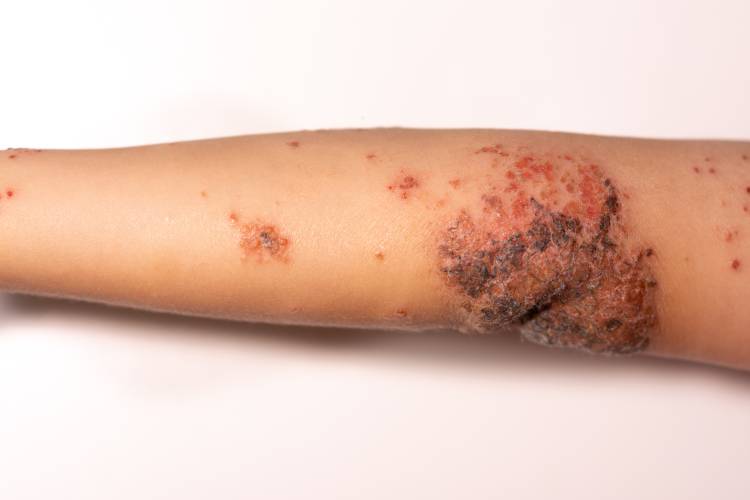
History taking and a visual examination should allow exclusion of bullous impetigo (typically, large fluid-filled blisters on the trunk, arms and legs of infants), recurrent impetigo and other skin conditions that might look similar. These could include:
- Skin infections and infestations
- Bacterial skin infections — cellulitis, ecthyma, erysipelas, staphylococcal scaled skin syndrome, necrotising fasciitis
- Fungal skin infections — candidiasis, tinea corporis/capitis
- Parasitic infestations — scabies
- Viral infections — varicella zoster or herpes simplex
- Non-infective skin conditions
- Dermatitis — atopic or contact dermatitis
- Insect bites
- Burns and scalds
- Drug reactions
- Other skin disorders — pemphigus vulgaris, bullous pemphigoid, lupus erythematosus, erythema multiforme or Sweet's Syndrome.
Management options
Antibacterial treatment is recommended for impetigo to shorten the course of illness and reduce the chances of spreading it to other sites on the body or other people.
Topical treatment with a five-day course of hydrogen peroxide 1% cream is first-line treatment for localised non-bullous impetigo. A five day course of oral flucloxacillin is first-line treatment for widespread non-bullous impetigo.
If flucloxacillin is indicated, remember to check for penicillin allergy and supply an alternative (clarithromycin or erythromycin subject to inclusion/exclusion criteria) if necessary.
While antimicrobial treatment is appropriate for impetigo, patients/parents need to understand how to use the treatment correctly. The CHESTSSS consultation structure, developed by the Royal College of General Practitioners, provides a useful framework.
A useful way to think about the consultation is to cover the 3 E's – Empathise, Evaluate and Educate. Table 1 shows how the CHESTSSS framework could be tailored to structure consultations about impetigo. This also provides an opportunity to educate patients about appropriate and effective use of antibiotics and to reinforce good antimicrobial stewardship.
| Table 1: Communicating with patients and parents about treatment decisions for impetigo | |
|
C Concerns – Ask directly: What are you most worried about? |
Concerns about appearance and risk of spreading |
|
H History and examination. Discuss what you see and relate to relevant history |
Provide a commentary. Describe how you are confirming diagnosis of localised or widespread non-bullous impetigo |
|
E Ask specifically about prior knowledge and Expectations. Patients who appear 'demanding' may just be seeking reassurance |
Antibiotics may be expected but topical antimicrobial treatment (hydrogen peroxide 1%) may be most appropriate for uncomplicated, localised impetigo |
|
S Provide non-serious explanation for Symptoms |
Impetigo is an infection of the uppermost layer of skin – it looks dramatic but is not deep seated and heals without scarring |
|
T Be specific about illness Timeline/usual course |
Impetigo clears in 2-3 weeks untreated and more quickly if treated |
|
S Explain Shortcomings of antibiotics |
Topical treatment is effective for impetigo. Hydrogen peroxide cream is appropriate for most cases of localised impetigo. Oral antibiotics are required for widespread impetigo. There is no need for topical and oral antibiotics |
|
S Self-care advice |
Good hygiene measures are important to avoid spreading infection to other sites and to other people. Patients should stay away from school/work until lesions are healed, dry and crusted, or for 48 hours after starting treatment |
|
S Provide Safety-netting advice |
Provide patients with specific information on red flag symptoms and when they should seek further help |
| Check understanding | Summarise what has been found and your advice. Check that the patient is reassured and satisfied with what you have advised |
Self-care advice
Ensure that patients and parents/carers get the best out of treatment by providing self-care advice:
- Gently remove crusts by washing with antibacterial soap/liquid skin wash before applying the hydrogen peroxide cream
- Wash hands before and after putting the cream or ointment on the impetigo
- Don't share towels or flannels until the infection has cleared. Always use a clean cloth each time to dry the affected area
- Avoid touching patches of impetigo as this may spread the infection to other areas
- Always wash hands with soap after accidentally touching the area
- Launder the patient's towels and bed linen on the hottest available setting (at least 60°C) with the addition of laundry bleach. Always wash hands with soap after touching the affected area
- Children with impetigo should be kept off school or nursery until affected areas have healed, or 48 hours after starting antibiotic treatment.
Using the impetigo protocol and PGDs
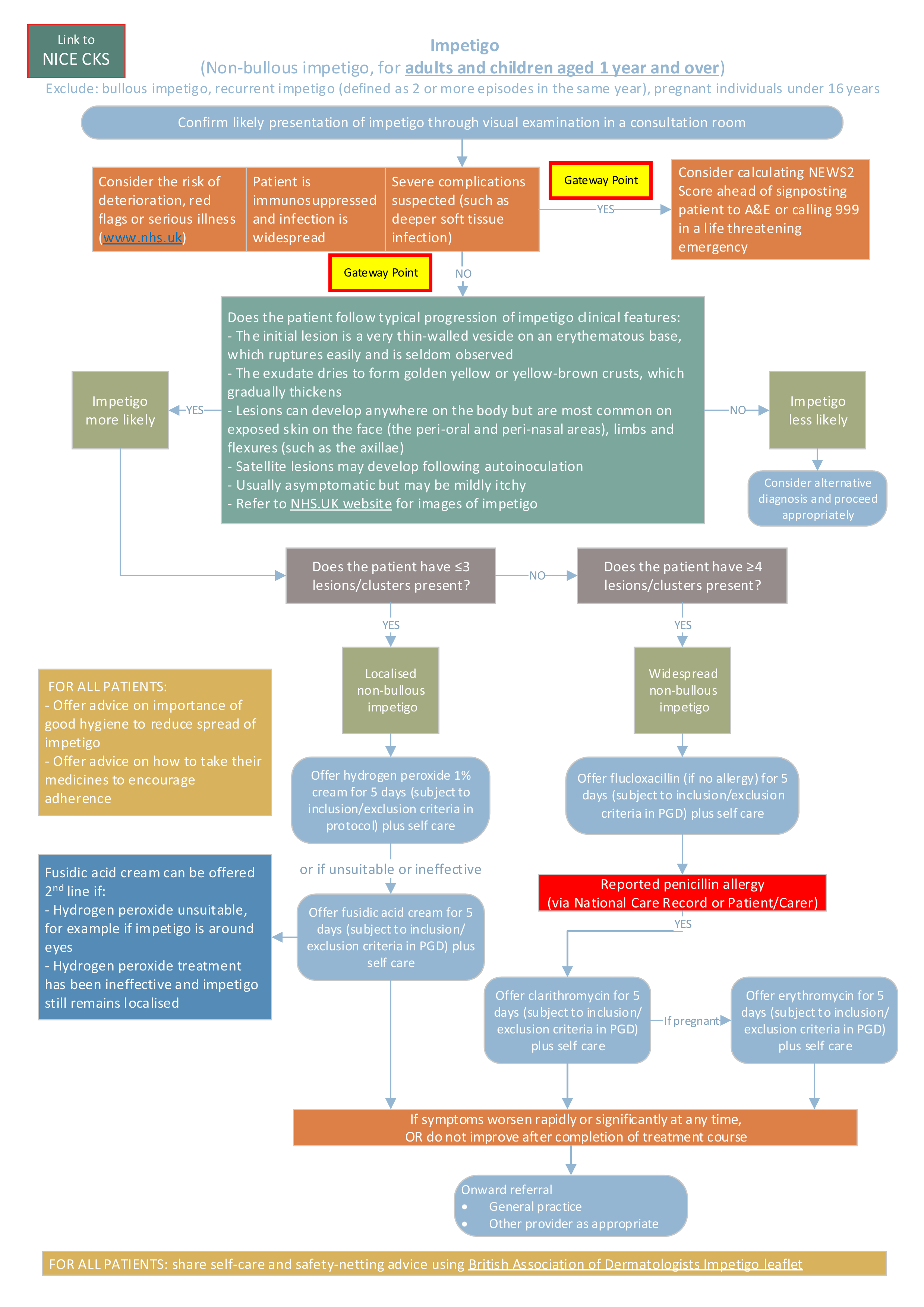
For patients in whom impetigo is likely, there are two topical and three antibiotic treatment options:
For localised non-bullous impetigo (three or fewer lesions/clusters present) in children over 1 year and adults who are systemically well and not at high risk of complications
- Hydrogen peroxide 1% cream
- Fusidic acid 2% cream – where hydrogen peroxide 1% cream is unsuitable (e.g. impetigo around the eyes) or ineffective
For widespread non-bullous impetigo (four or more lesions/clusters present) in children aged 1 year and over and adults who are systemically well and not at high risk of complications.
- Flucloxacillin
- Clarithromycin – where flucloxacillin is not appropriate due to hypersensitivity
- Erythromycin – where pregnancy is suspected and where flucloxacillin is not appropriate due to hypersensitivity.
Check the patient meets the criteria for inclusion, then determine whether they might be excluded from treatment. General criteria for exclusion include:
- Individuals aged under 1 year
- Pregnancy or suspected pregnancy in individuals aged under 16 years
- Currently breastfeeding with impetigo lesion(s) present on the breast
- Individuals who are immunosuppressed or are currently taking immunosuppressants (including systemic corticosteroids) or immune modulators
- Severely immunosuppressed individuals (as defined in Chapter 28a of the Green Book)
- Recurrent impetigo (two or more episodes in the same year)
- Failed previous topical or oral treatment (including antimicrobials) for the current episode of impetigo
- Currently active underlying skin condition (e.g. uncontrolled eczema or contact dermatitis, or current episode of scabies, chickenpox or eczema herpeticum)
- Any open wounds affecting the application area or the immediate vicinity
- Bullous impetigo (characterised by flaccid fluid-filled vesicles and blisters (often with a diameter of 1-2cm), which can persist for 2-3 days
- Systemically unwell
- Signs/symptoms of a more serious condition/illness (e.g. swelling, large blisters, pain, pus or spreading redness).
Additionally, for antibiotic PGDs:
- Hypersensitivity reactions (e.g. anaphylaxis) to beta-lactam or macrolide antibiotics
- Individuals following a ketogenic diet
- Previous or current known methicillin resistant Staphylococcus aureus (MRSA) colonisation or infection
- Known or suspected liver disease
- Known chronic kidney disease (CKD) stages 4 or 5 (eGFR<30ml/min/1.73m²)
- Less than 3 days before receiving, or within 3 days after receiving, oral typhoid vaccine.
Refer to the PGDs for a specific list of exclusions for:
- Hydrogen peroxide 1% cream
- Fusidic acid 2% cream
- Flucloxacillin
- Clarithromycin
- Erythromycin.
In addition to medication, each patient treated under a PGD (or their parent/carer) should be:
- Given the appropriate medicine patient information leaflet
- Provided with the British Association of Dermatologists Impetigo leaflet www.bad.org.uk/pils/impetigo
- Signposted to NHS Health A-Z: Impetigo www.nhs.uk/conditions/impetigo
- Offered self-care advice:
- Impetigo stops being contagious:
- 48 hours after starting to use hydrogen peroxide cream or antibiotics
- When patches dry out and crust over
- To help stop impetigo spreading or getting worse while it's still contagious:
- Stay away from school or work
- Keep sores, blisters and crusty patches clean and dry
- Cover them with loose clothing or gauze bandages
- Wash hands frequently, especially after accidentally touching the area
- Wash flannels, sheets and towels at a high temperature (at least 60°C) with the addition of laundry bleach
- Wash or wipe down toys with detergent and warm water if children have impetigo
- Do not touch or scratch sores, blisters or crusty patches
- Do not have close contact with children or people with diabetes or a weakened immune system
- Do not prepare food for other people (food handlers are required by law to inform employers immediately if they have impetigo)
- Do not go to the gym or play contact sports such as rugby or football
- Always use a clean cloth to dry the affected area if necessary.
- Impetigo stops being contagious:
Medicines that can be supplied, dose and frequency
Duration of treatment – five days
| Medication | Dose and frequency |
| Hydrogen peroxide 1% cream (e.g. Crystacide 1% cream) | Apply a thin layer to the affected area(s) up to 3 times a day. Use enough of the cream to cover the lesion(s) with a thin layer. Wash hands after application. |
| Fusidic acid 2% cream | |
|
Flucloxacillin 250mg capsules 500mg capsules 125mg/5ml oral soln or susp x 100ml 250mg/5ml oral soln or susp x 100ml (or sugar free alternatives) |
Children aged 1 year and over and under 2 years of age: 125mg four times a day Children 2-9 years: 250mg four times a day Children 10-17 years and adults: 500mg four times a day |
|
Clarithromycin 250mg tablets 125mg/5ml oral susp or soln x 70ml 250mg/5ml oral susp or soln x 70ml |
Children 1-11 years, body weight:
Children 12-17 years and adults: 250mg twice daily |
|
Erythromycin 250mg tablets 250mg gastro-resistant tablets 500mg tablets 125mg/5ml oral susp or soln x 100ml 250mg/5ml oral susp or soln x 100ml (or sugar free alternatives) |
Young people and adults aged 16 years and over: 500mg four times daily |
Last reviewed: September, 2026
Next scheduled review: September, 2027

Share:


In Pharmacy First